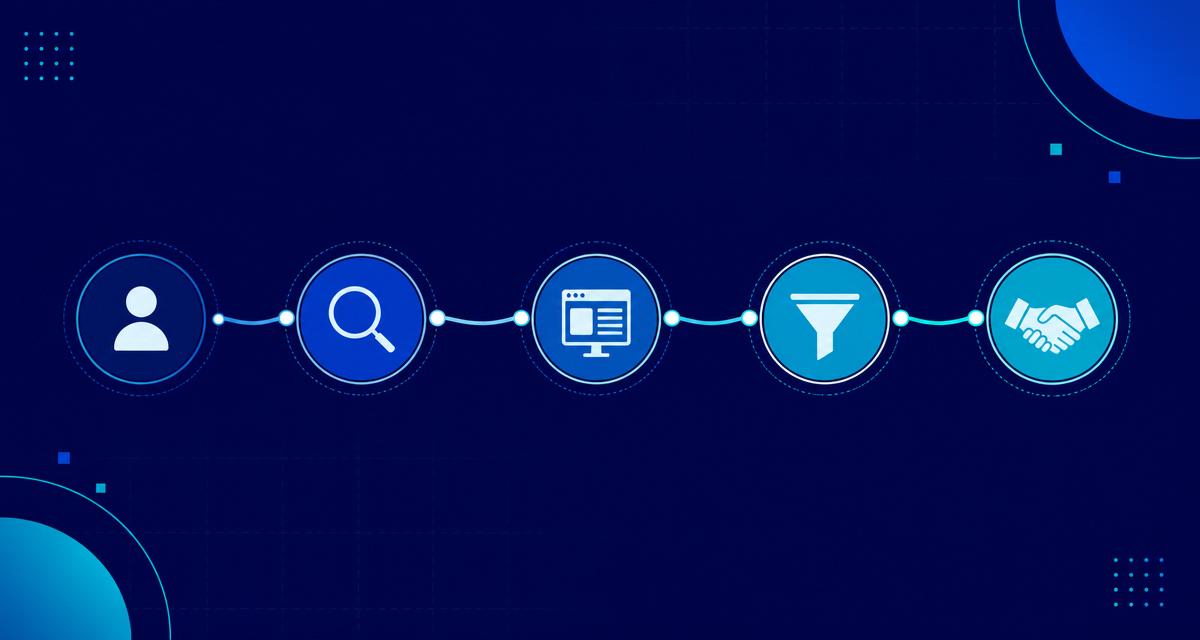
Let’s follow one visitor from click to signature. Nordwerk is a made-up German machine-builder we’ll use as a running example. Everything below is illustrative — real journeys wobble more — but the shape is honest, and the steps are ones you can copy this week.
Step 1 — Somebody clicks
On Tuesday at 10:47, someone at Nordwerk types your product name into Google, opens two results and lands on your homepage. They don’t know you yet. They don’t sign up. They read the headline, scroll, click ‘How it works’, and leave after four minutes. That’s the entire event. Traditional analytics would file this under ‘one anonymous session’ and forget it.
Step 2 — The company appears
With visitor identification switched on, the same session shows up in a short list the next morning: ‘Nordwerk GmbH — 4 minutes — homepage, how-it-works, pricing’. You now know two useful things: a real company visited, and they cared enough to reach the pricing page. That’s the difference between a number and a lead.
Plain word
A ‘lead’ here just means: a company that showed real interest. It’s not a signed contract. It’s a reason to pay attention.
Step 3 — You decide it’s worth 30 seconds
You open Nordwerk’s public LinkedIn page. 120 employees. Automation subsector. Perfect fit for your ICP (that’s just marketing shorthand for ‘the kind of customer you serve best’). You spend 30 seconds looking at the two most senior people who plausibly own this problem — an operations director and a plant manager — and shortlist them.
Step 4 — You send one short message
No cold pitch. Something honest and small: ‘Saw someone from Nordwerk on our how-it-works page this week. If you’re looking into visitor identification for your industrial site, happy to answer questions. No pitch attached.’ That’s it. No template. No cadence. One human sentence.
Two things happen with this kind of message. Most don’t reply — that’s fine, you spent one minute. A meaningful share do reply, because the message is specific and true. Nordwerk’s ops director writes back the next morning: ‘Interesting timing — we were just discussing this. Do you have 20 minutes on Thursday?’
Step 5 — The conversation, not the pitch
Thursday’s call is not a demo. It’s a listening session: what problem, why now, who else is involved. You take notes. You send a two-paragraph follow-up the same day with a link to one specific case relevant to their subsector. The following week they involve a second colleague. Two weeks later they trial the product. A month after that, they buy.
| Step | What happens | Time it takes you |
|---|---|---|
| 1. Click | Someone from a company visits | 0 minutes |
| 2. Company appears | Named in your list | 0 minutes |
| 3. Quick fit check | You skim LinkedIn | 30 seconds |
| 4. One honest message | Short, specific, no pitch | 1 minute |
| 5. Conversation | Listening call, then trial | 20 minutes |
The honest bit
Nordwerk is fictional. Journeys in real life stall, restart, get handed to a colleague, disappear for six weeks, come back after a board meeting. The five steps above are the shape — the timing varies. What consistently helps is seeing the company early and reaching out like a human, not like a sequence.
- Related: [The 5-step workflow from anonymous visitors to meetings](/blog/anonymous-visitors-to-sales-meetings-5-step-workflow)
- Related: [Recognising B2B buying signals in your traffic](/blog/recognizing-b2b-buying-signals-in-website-traffic)
- Related: [Why your best leads never fill out forms](/blog/why-your-best-leads-never-fill-out-forms)

Published by
lead.box Team
More articles
See lead.box on your own traffic
Start free — no card, no sales call required. Or book a 20-minute walk-through if you want the guided tour.